
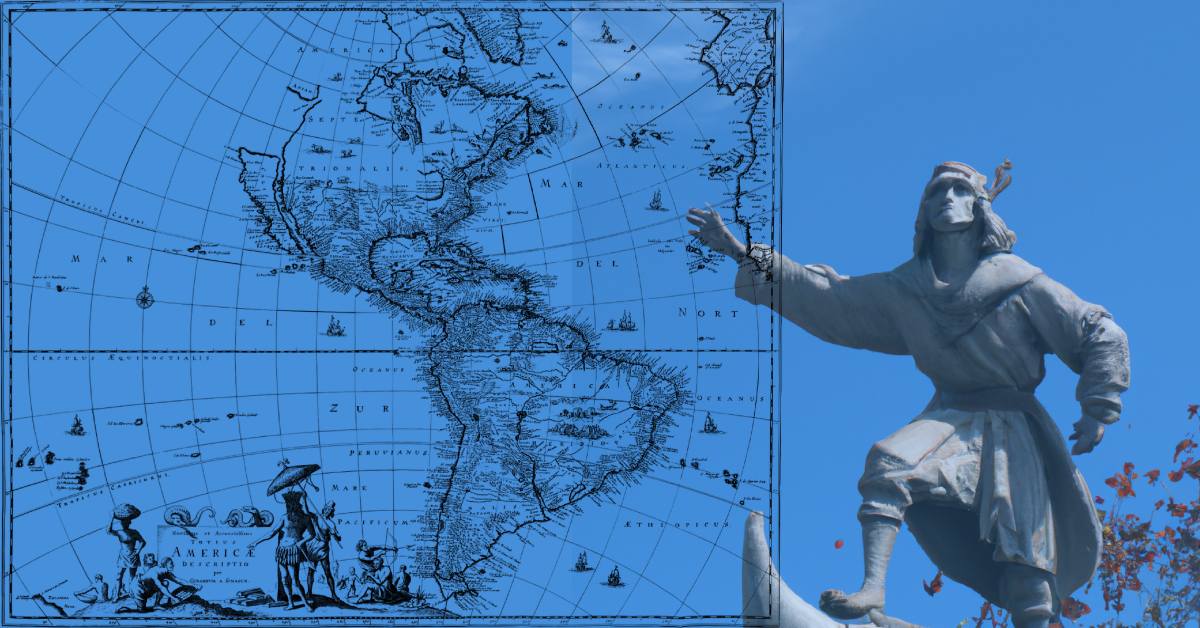
Christopher Columbus (Cristoforo Colombo in Italian; Christoffa in Ligurian dialect) was born in Genoa in 1451. He had little education as a boy, and only learned to read and write as an adult. So he went to sea, as did many Genovese boys, and voyaged in the Mediterranean.
In 1476 he was shipwrecked off Portugal, found his way ashore, and went to Lisbon. He also traveled to Ireland and England and later claimed to have gone as far as Iceland. He was in Genoa in 1479, returned to Portugal, and married. His wife, Dona Felipa, died soon after his son, Diego, was born.
By this time, Columbus had become interested in westward voyages. He had learned of the legendary Atlantic voyages and sailors’ reports of land to the west of Madeira and the Azores.
Are you Italian-American?
Take the quiz to test your knowledge of our culture!
Acquiring books and maps, he accepted Marco Polo’s erroneous location for Japan, 1,500 miles East of China. He also accepted Ptolemy’s underestimation of the circumference of the Earth and overestimation of the size of the Eurasian landmass.
For these inaccurate assumptions, he came to believe that Japan was about 3,000 miles west of Portugal–a distance that could be easily sailed in existing vessels of the day. His idea was furthered by the suggestions of the Florentine cosmographer Paolo dal Pozzo Toscanelli.
In 1484, Columbus sought support for an exploratory voyage from King John II of Portugal, but was refused. The Portuguese also underestimated the distance, but believed it to be beyond the capabilities of existing ships.
In 1485 Columbus took his son Diego and went to Spain, where he spent almost seven years trying to get support from Queen Isabella. He eventually succeeded and the rest, as they say, is history.
The Voyages of Columbus
Christopher Columbus completed four voyages to the New World in the late 15th and early 16th centuries.
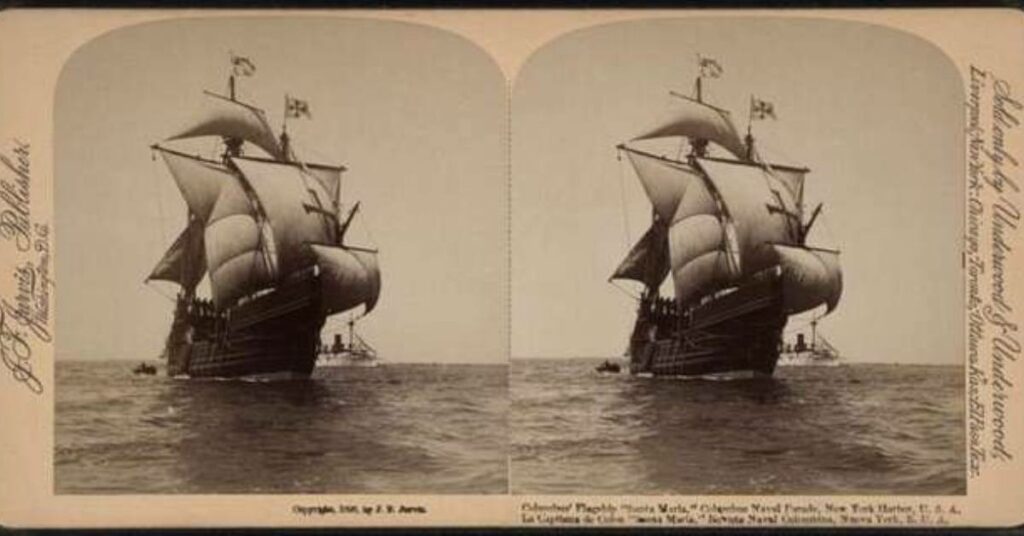
His first voyage, in 1492, was sponsored by King Ferdinand and Queen Isabella of Spain. Columbus set sail with three ships, the Nina, Pinta, and Santa Maria, and after a journey of over two months, he landed on an island in the Bahamas, which he named San Salvador. He also explored Cuba and Hispaniola before returning to Spain.
In 1493, Columbus embarked on his second voyage, this time with a larger fleet of 17 ships. He explored more islands in the Caribbean, including Puerto Rico and Jamaica, and established the first Spanish colony in the New World on the island of Hispaniola, in what is the modern day country of the Dominican Republic. This colony was named Isabela, after their patron queen.
Columbus’ third voyage, in 1498, took him to the mainland of South America, where he explored the Orinoco River in present-day Venezuela. He also explored Trinidad and the coast of modern-day Brazil before returning to Hispaniola.
In 1502, Columbus set out on his fourth and final voyage, hoping to find a route to the East Indies. He explored the coast of Central America and the Yucatan Peninsula before his ships were damaged in a storm and he was forced to land on the island of Jamaica. Columbus and his crew were stranded on the island for over a year before they were rescued and returned to Spain.
Contrary to what some believe, Columbus never actually set foot on the landmass that is now the continental United States.
Overall, Columbus’ voyages were significant because they opened up the New World to European exploration and colonization, leading to the establishment of permanent European settlements in the Americas.
Some lament that his expeditions also had devastating consequences for the indigenous populations, as European diseases and forced labor practices led to the decimation of entire communities.
While the consequences are undoubtedly true, it is difficult to blame one man who could not possibly have foreseen such unfortunate events, perpetrated by future generations of settlers from many countries over many years. He was merely a sailor, compelled by his bloodline to explore the great seas…
“And the sea will grant each man new hope, as sleep brings dreams of home.”
Christopher Columbus