
Click here for Books, Music and Italian Products
Albert
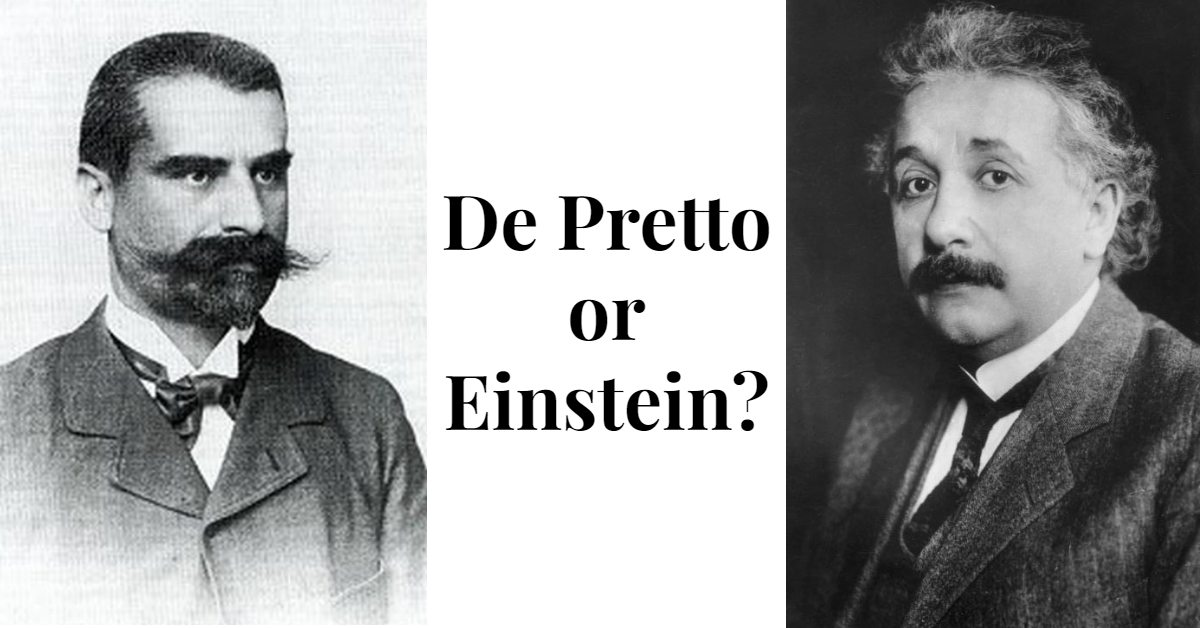
Einstein and Olinto De Pretto
A
review by Michael Falotico of the book written by Professor Umberto
Bartocci
Umberto Bartocci, Professor of Mathematics at the University of Perugia,
Italy,
in his book, "Albert Einstein e Olinto De Pretto: la vera
storia
della formula piu' famosa del mondo" (Albert Einstein and Olinto De
Pretto,
the true history of the most famous formula in the world) has shown to us what
can happen if one digs long enough through old Italian archives. His book
literally re-writes the history of science in the 20th Century.
Professor Bartocci proves that an Italian first formulated the famous
equation E=mc^2.
An
industrialist named Olinto De Pretto, a native of the Veneto region of
Italy,
published an article in which he gave, in its final form, the equation E=mc^2.
This article was published on June 16, 1903, and published again in February 27,
1904, the second time in the Atti of the Reale Instituto Veneto di Scienze. De
Pretto thereby preceded Einstein's famous 1905 "E=mc^2" paper by at
least a year-and-a-half.
To
Professor Bartocci's credit, he attaches the complete text of the De Pretto
article as an appendix to his book so that the reader can decide for
himself/herself if De Pretto was a true precursor to Einstein.
In the article, Olinto De Pretto actually comments on how amazing his
discovery is. De Pretto could
hardly believe his mathematical discovery. This formula, of course, would later
be the theoretical basis for the atomic bomb. Indeed, decades later, when
another Italian, Enrico Fermi, was
working on nuclear reactions, Fermi credited the famous equation E=mc^2
(attributed to Einstein) for formulating the theoretical underpinnings that made
nuclear reactions possible.
De Pretto himself understood the significance of his discovery. Speaking
of E=mc^2 he wrote (my translation), "To what astonishing result has our
reasoning brought us? Nobody would easily admit that stored in a latent
state, in a kilogram of whatever material, completely hidden from our
investigations, there comes into play such a sum of energy.
The idea would be adjudged crazy!" De Pretto was 46 years old when
he made this discovery.
Unfortunately,
he would never be in a position to take credit for it.
In
1921,
a year before Einstein received the Nobel Prize, De Pretto was shot dead,
murdered by a woman over a business dispute.
De Pretto was in the process of having a complete book of his scientific
ideas published when he was killed.
Could
Einstein have copied from De Pretto? Nobody can absolutely prove that
Einstein
saw De Pretto's article but Professor Bartocci offers some intriguing
speculation.
Professor
Bartocci has traced a link between De Pretto and Einstein, through Einstein's
best friend, Michele Besso. Besso is the only person credited in the famous
E=mc^2 paper of 1905. Throughout
all of his famous papers on 1905, Einstein gives no sources or citations. The
only credit given to anyone is a brief mention of his friend Michele Besso. Why
the lack of citation of any source material?
Interestingly, Besso was originally from the Veneto region of Italy; his
native tongue was Italian. The city of Vicenza, Italy, again in the Veneto
region, was where Olinto De Pretto was from.
Michele Besso was close to his uncle, Beniamo Besso, who lived in
Rome.
Beniamo Besso worked as an engineer in Rome with Olinto De Pretto's brother,
Augusto De Pretto. Perhaps Augusto
passed on Olinto's discovery to Beniamo Besso who in turned told Michele Besso
who in turn told Einstein—or so goes the thread.
While the De Pretto-to-Besso-to-Einstein link is seemingly tenuous, it
must be noted that Einstein was well aware of other groundbreaking work by
Italian physicists (having read deeply the Italian physics literature).
During the very same "anno mirabilis" of 1905, when Einstein
published his famous four physics papers in the Annalen der Physik (including
the paper that derived the E=mc^2 formula), he also published in the very same
Annalen der Physik reviews of articles written by Italian physicists. For example, the Collected Papers of Albert Einstein,
published by Princeton University Press, contains a review written by Albert
Einstein in March 1905 of the an article written by Arturo Giammarco, "A
Case of Corresponding States in Thermodynamics" Einstein also wrote a
review of Giuseppe Belluzzo, "Principles of Graphic Thermodynamics."
This shows that Einstein was reading rather deeply in the Italian physics
literature at the time.
Perhaps
the Besso connection is probably unnecessary although it could very well have
happened. Einstein, too, could have
stumbled across De Pretto's formula on his own.
The Veneto region is not that far from where Einstein was then living in
Switzerland. Indeed, Albert
Einstein was quite fluent in Italian. According to Abram Pais in his biography
of Einstein, "Subtle is the Lord",
when Einstein graduated from high school in Aarau, Germany, he was
required to take exams in both the German language and the Italian language.
Out of a maximum score of 6,Einstein received a score of 5 in German (his
native tongue) and also a score of 5 in Italian! This in and of itself is proof
of Einstein's conversance in Italian; Einstein could write as well in Italian as
he could in his native German tongue.
Also, the Collected Papers of Albert Einstein, published by Princeton
University Press, notes that Einstein spoke Italian.
Of course, Einstein had lived in Italy during his youth, and Einstein's
father is buried in Milan. Further, in order for Einstein to gain Swiss
citizenship (a requirement for him to work in the Berne patent office since that
was a government job) it could only help him if he could show proficiency in
Italian, which, along with German and French, is one of the three official
languages of Switzerland. Finally, there are still extant postcards written by
Einstein in Italian as well as living Italians who spoke to Einstein in his
later years who can attest to his fluency. There is no doubt that Einstein spoke
Italian well. Indeed, the above cited reviews of the Italian physics literature
prove the point. It is impossible
to say if Einstein ever saw the De Pretto article.
All one can say with any assurance is that if Einstein indeed saw the
article, Einstein's Italian language skills were strong enough that he could
read it.
When
Einstein did publish his famous article in 1905 wherein he gave a variation of
the famed "E=mc^2" formula, he titled this "discovery" in
the form of a question. Published
in November, 1905, in Volume 18, pages 639-641, the title of Einstein's paper
was phrased as a question, "Does theInertia of a Body Depend upon its
Energy Content?"
Professor Bartocci finds it curious that Einstein would title his article
in the form of a question. Perhaps
he was not quite sure of its significance or perhaps he wanted the title in
question form in order to later attribute the idea to someone else should the
formula prove incorrect. Or perhaps
Einstein is making a veiled reference to something he saw in the Italian physics
literature.
Professor Bartocci spends much of his book discussing how difficult it
was to get anyone to believe him. The
Einstein "establishment" is so strong, and the mythology surrounding
Einstein so ingrained, that no one in Italy would publish his book.
Once he did find a publisher, he could not get the book reviewed. It was only in Great Britain, far from Italy, that word
leaked out regarding the book.
On the face of it, the Einstein story is irresistible.
How one obscure patent clerk single-handedly published in the same year
(1905) four articles that, respectively, explained Brownian motion; explained
the photo-electric effect; formulated the equation E=mc^2, and invented the
theory of relativity! For one man
to have done all that, and all in the same year, is nothing short of miraculous. Any one of these discoveries would have assured Einstein a
place in history. To have
single-handedly made all four and published them all in the space of a year,
well, that is astonishing genius.
Perhaps the British reviewers are a bit more cynical.
They publicized Professor Bartocci's findings when no one else would.
Perhaps Einstein, undoubtedly a brilliant man, did not do quite all that
he is said to have done.
What is absolutely indisputable is that the formula was published, not
once but twice, in the Italian physics literature. Its authorship should rightly
be credited to the industrialist, Olinto De Pretto.
Please
don't take my word for any of this: read the book yourself.
It
can be obtained from
Societa'
Editrice Andromeda, via S.
Allende1, 40139
Bologna,
Italy. Telephone 051.548721 -
051.490439
FAX
051. 491356
www/alinet.it/andromeda
e
mail: andromeda@posta.alinet.it
Back to Famous Italians
Back to The Main Page