
The role of Italians in American history should not be underestimated. For starters, America was “discovered” by one Italian, Christopher Columbus, and named after another, Amerigo Vespucci.
Early on, other Italians figured prominently, as well. Giovanni Caboto (John Cabot) planted English and Venetian flags in Maine or Newfoundland, Florentine Giovanni da Verrazzano in 1524 explored northward from the Carolina coast to Nova Scotia. One (alleged) Italian, William Paca, signed the Declaration in 1776. By 1782 he would become Governor of Maryland.
But the Italians were few and far between in those first few centuries. Then during the first decades of the 1800s, a slow trickle of emigrants from Italy started. Some of them were prominent. Giuseppe Garibaldi, the liberator of Italy, lived for a time on Staten Island. Lorenzo da Ponte, the librettist of Mozart, spent later years in New York and even taught at Columbia College as their (first) professor of Italian literature.
But the 1880 census still reported a total of only 40,000 Italians in the United States, over a quarter of them in New York City.
That figure was destined to grow rapidly. Until Italy unified in 1861-1871, most emigration had been strictly forbidden. For a couple of decades after that, most immigrants were from northern Italy and left not for America, but for seasonal work in France, Germany, or Switzerland.
After 1880, Italians from the south of the country began to depart in great numbers. With some exceptions they were poor, less educated, and much more provincial and unsophisticated than the Northerners.
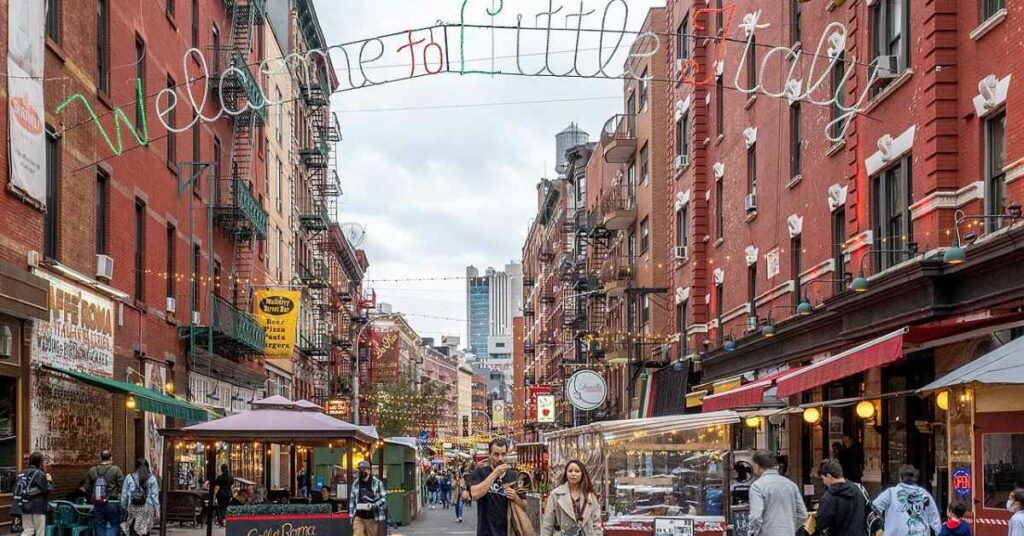
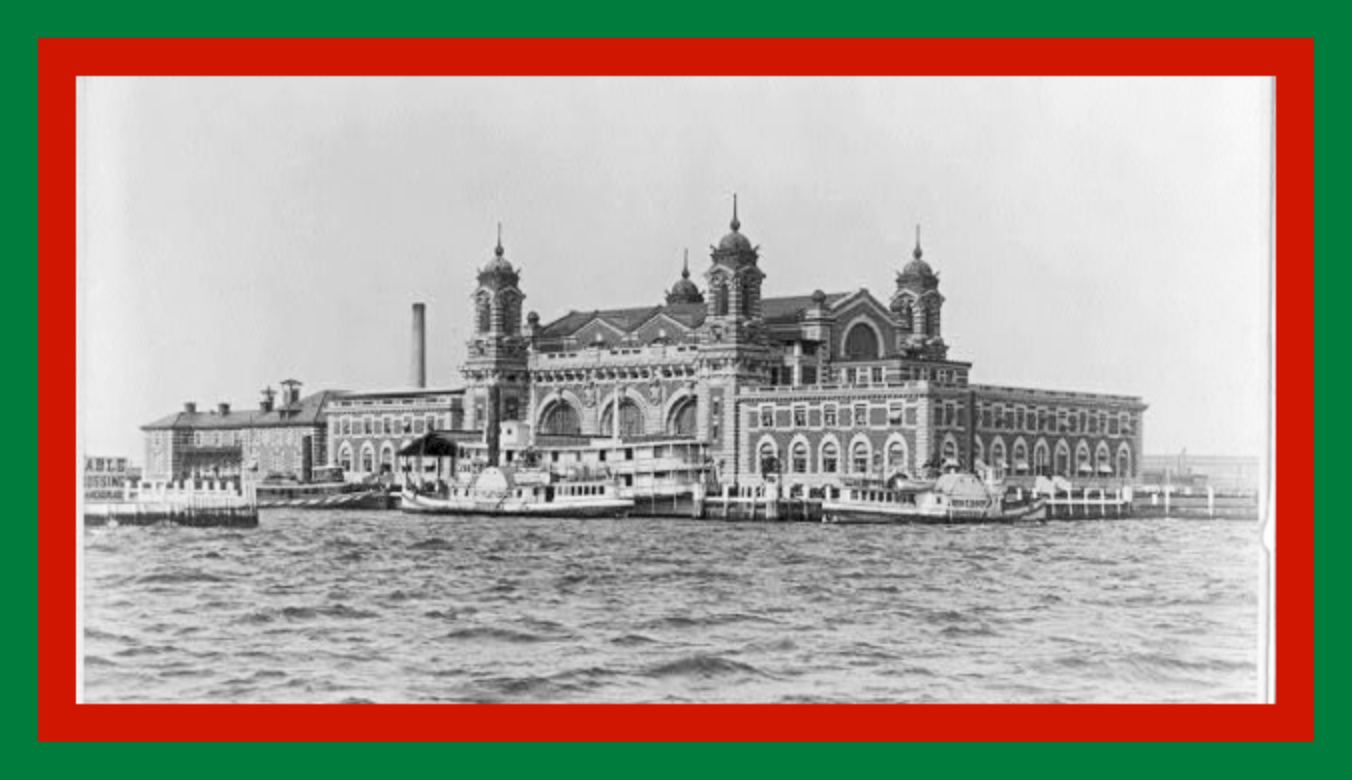
In the 1880s, 268,000 Italians came to The United States, although many in this first wave went back home after saving enough money to improve their status in Italy. In the 1890s, 604,000 came, and from 1900 to 1910 the all-time high of 2,104,000. By the 1930s, one-sixth of New York’s teeming millions were from southern Italy. Today, Italians rank second in number only to Germans among American ethnic groups.
Italian-Americans in U.S. History
Then over the years, Italian-Americans began playing prominent roles in American history. There are sports heroes, such as Joe DiMaggio and Rocky Marciano. There are filmmakers such as Francis Ford Coppola and Martin Scorsese. Several Italian-Americans rose to prominence in politics such as Mario Cuomo, the mayor of New York City, then later his son Andrew, the governor of New York State.
Italians also have a great tradition in scientific innovation, all the way back to the likes of Leonardo DaVinci, Alessandro Volta, and Leonardo Fibonacci. This legacy continued with brilliant minds like Olinto De Pretto, whose formulas pre-dated Einstein’s, and Enrico Fermi, who was born in Rome, but emigrated to the U.S. to work on the Manhattan Project, leading to the development of the nuclear bomb.
There are many, many others, of course, such as:
Fiorello LaGuardia (1882-1947) – LaGuardia was the first Italian-American to serve as mayor of New York City and was known for his progressive policies and reforms.
Frank Sinatra (1915-1998) – A famous singer and actor, Sinatra was a cultural icon in the mid-20th century and helped to popularize the “rat pack” lifestyle.
Mario Puzo (1920-1999) – Puzo was an Italian-American author who wrote “The Godfather,” which became one of the most popular books and movies of all time.
Antonin Scalia (1936-2016) – Scalia was an Italian-American jurist who served as a Supreme Court justice from 1986 until his death in 2016.
Geraldine Ferraro (1935-2011) – Ferraro was the first Italian-American woman to be elected to the United States Congress and served as the Democratic Party’s vice-presidential nominee in 1984.
But as time goes on, families from different backgrounds merge and ethnic identity becomes, slowly, gradually, less prominent. Still, it’s safe to say that Italian-Americans in the 21st still carry the pride of their roots with them, and continue to celebrate the culture and traditions of their ancestors from the Old Country.
There are important Italian-American organizations all over the United States. If you’re interested in learning more about your cultural heritage, find your local chapter and get involved to help preserve our collective history.